How AI Is Changing URL Tracking & Link Intelligence
AI URL Tracking & Link Intelligence: The Complete 2026 Guide for Modern Businesses
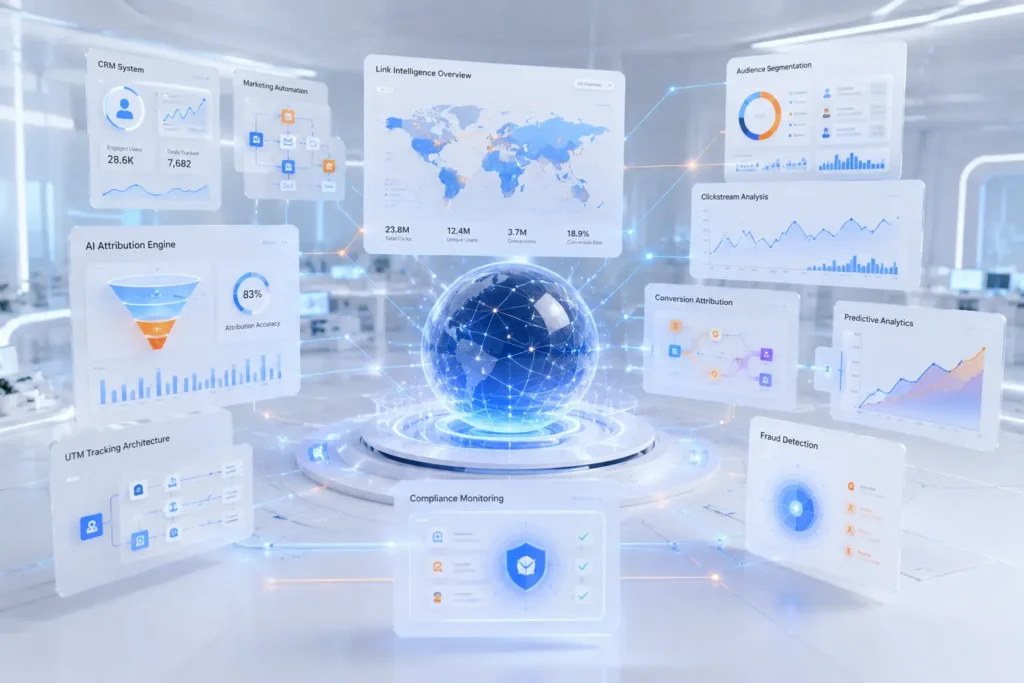
Every link you share carries a story — but most businesses only read the first sentence. Traditional click counters tell you how many people clicked. They rarely tell you who clicked, why they clicked, or what happened after. AI URL Tracking & Link Intelligence is changing that equation entirely. By layering machine learning, predictive analytics, and real-time behavioural modelling on top of conventional link data, modern platforms can now surface insights that were simply impossible five years ago. Whether you run a SaaS startup, manage a global enterprise marketing stack, or consult on digital transformation projects, understanding this shift is no longer optional — it is foundational.
What Is AI URL Tracking & Link Intelligence?
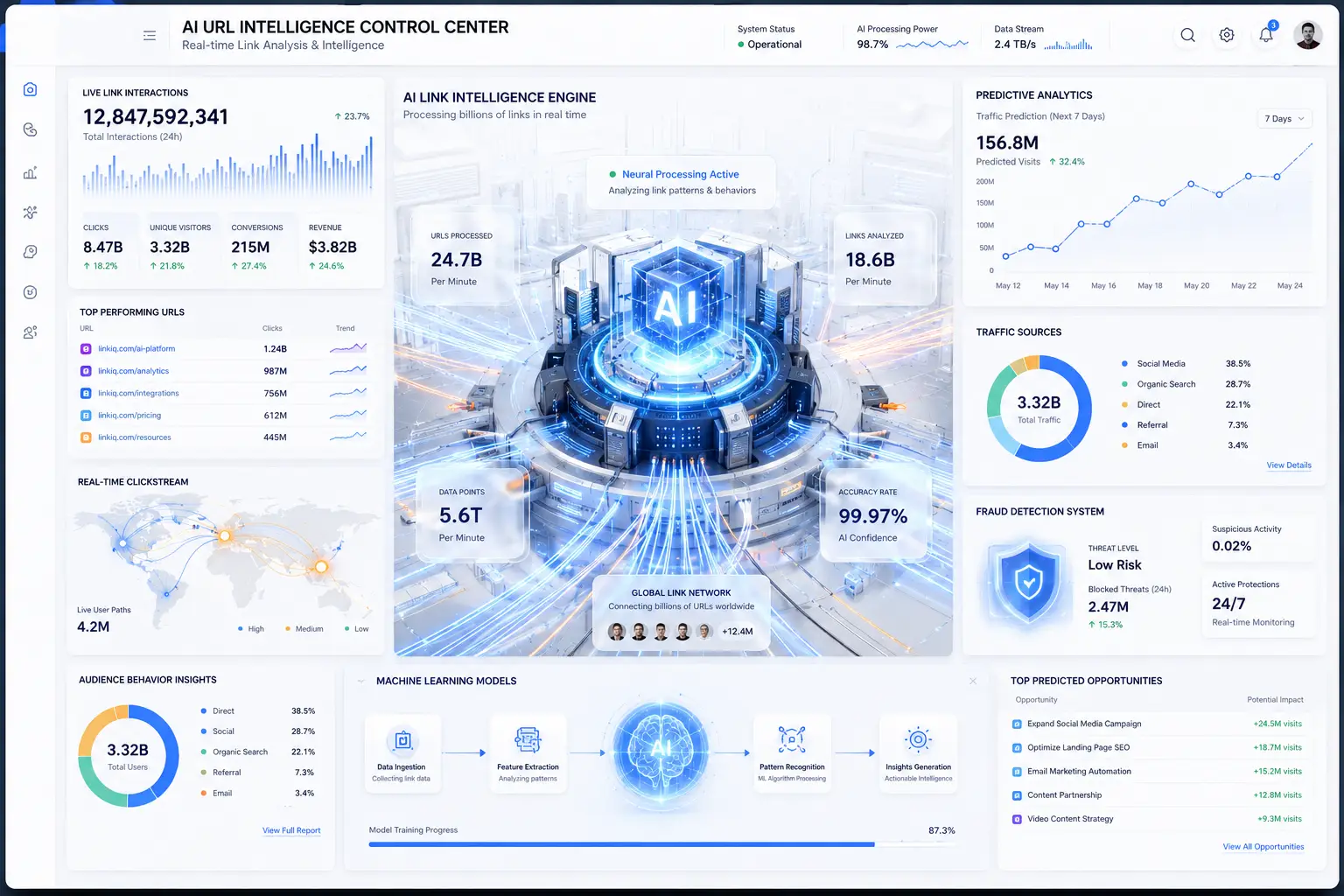
AI URL Tracking & Link Intelligence refers to the use of artificial intelligence and machine learning algorithms to collect, process, and interpret data generated by hyperlink interactions across digital channels. Unlike legacy analytics tools that record raw metrics (clicks, referrers, timestamps), AI-powered systems apply pattern recognition, anomaly detection, and predictive modelling to extract strategic meaning from link behaviour at scale.
A smart link analytics platform in this category does more than log a click. It identifies device fingerprints, maps audience intent signals, cross-references UTM parameters with CRM records, detects bot traffic in real time, and generates probabilistic forecasts about future engagement. The result is a dynamic, living intelligence layer that connects URL performance to revenue outcomes.
Core Components of AI-Powered Link Intelligence
- Real-time click stream processing: Ingesting millions of link events per second using stream analytics pipelines.
- Bot and fraud detection: Machine learning classifiers that separate human traffic from automated crawlers, click farms, and invalid clicks.
- Audience segmentation AI: Clustering algorithms that group link visitors by behaviour, geography, device, and intent signals — without relying solely on cookies.
- Predictive engagement scoring: Models that forecast which audiences are most likely to convert based on historical link interaction patterns.
- Cross-channel attribution: Connecting link data across email, social, paid media, SMS, and direct channels into a unified attribution model.
- Natural language link metadata analysis: NLP-powered classification of destination content to understand context and intent at the destination URL level.
Why Businesses Need AI URL Tracking & Link Intelligence in 2026
The digital landscape of 2026 is vastly more complex than the one marketers navigated a decade ago. Third-party cookies are disappearing. Privacy regulations such as GDPR, CCPA, and newer frameworks in Asia-Pacific are constraining traditional tracking methods. At the same time, audience journeys have fragmented across dozens of touchpoints. Without intelligent link analytics, businesses are flying blind.
According to Gartner’s marketing analytics research, organisations that invest in AI-driven data capabilities consistently outperform competitors in customer acquisition efficiency and marketing ROI. Link intelligence is one of the most accessible entry points into that capability stack — it requires no massive data warehouse project and delivers value from day one.
For businesses using URL shortening and link management platforms such as Trimu.io, layering AI intelligence on top of existing short link infrastructure provides an immediate competitive advantage. Every shortened link becomes a sensor — emitting behavioural data that the AI layer interprets and acts upon.
The Problem with Legacy Link Tracking
- Static click counts with no contextual enrichment.
- Inability to distinguish high-value human traffic from bot noise.
- Siloed data that does not connect to CRM, sales, or revenue systems.
- No predictive capability — only backward-looking reporting.
- Dependence on third-party cookies now being phased out globally.
- Manual reporting cycles that delay insight-to-action time by days or weeks.
Key Benefits of AI URL Tracking & Link Intelligence
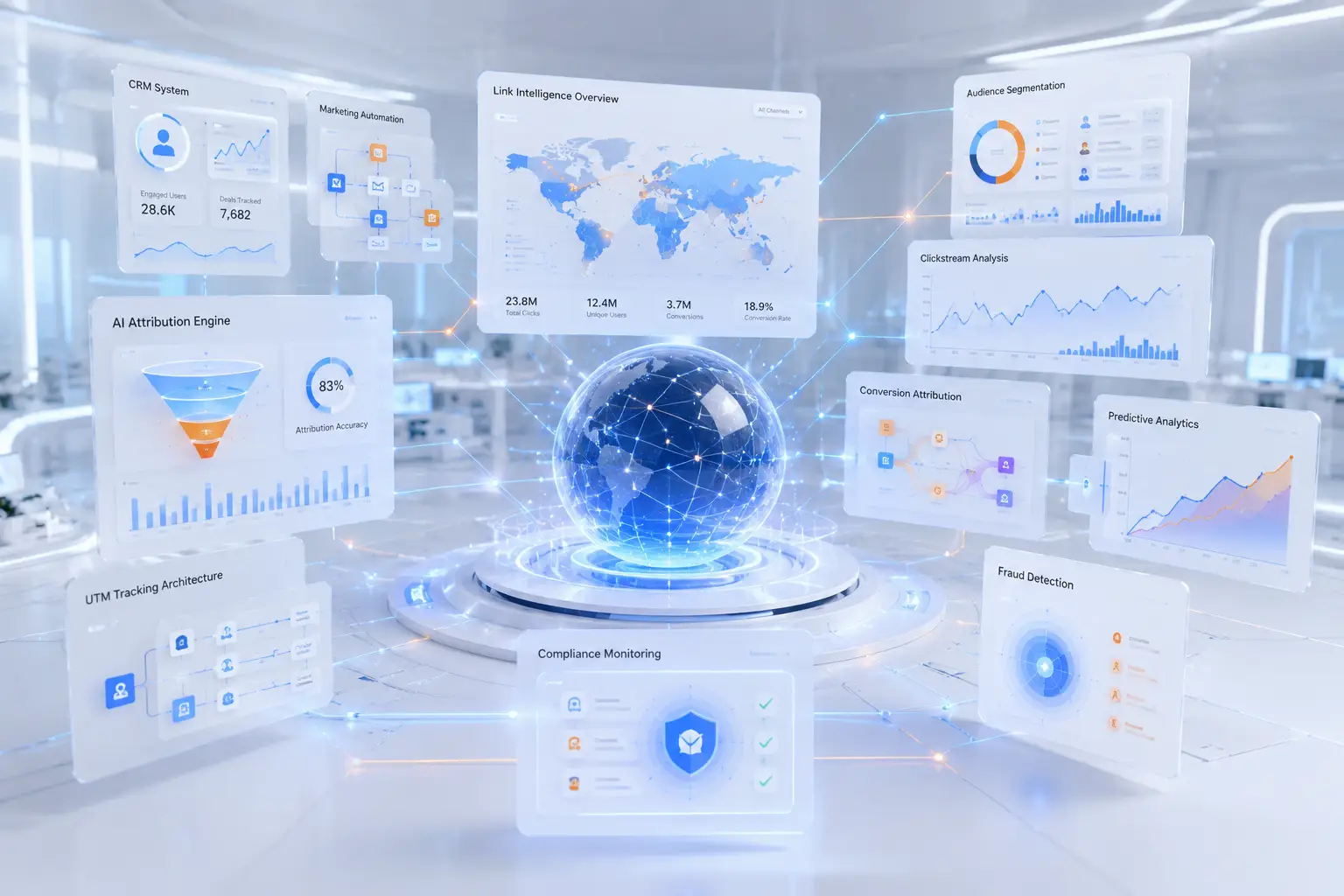
Implementing a smart link analytics platform powered by AI delivers measurable benefits across marketing, product, sales, and IT functions. Below are the primary value drivers that enterprise teams and growth-stage companies consistently report.
1. Dramatically Higher Data Quality
AI models filter invalid traffic with far greater accuracy than rule-based systems. Bot detection models trained on billions of link interactions can identify sophisticated invalid traffic — including headless browsers and residential proxy farms — that traditional IP blocklists miss entirely. This ensures that performance metrics reflect genuine human engagement, making campaign decisions far more reliable.
2. Real-Time Audience Intelligence
Every link click is a micro-signal. AI systems aggregate these signals to build behavioural profiles in real time — without relying on personally identifiable information. Marketers receive audience intelligence (device mix, geographic concentration, time-of-day patterns, content affinity signals) within seconds of links going live. This powers agile campaign optimisation that legacy tools simply cannot match.
3. Predictive Link Performance Forecasting
Predictive link tracking software uses historical engagement patterns to forecast how a link campaign will perform before it reaches peak distribution. This allows teams to allocate budget toward high-performing channels earlier, pause underperforming campaigns faster, and set realistic KPI benchmarks grounded in data rather than assumptions.
4. Unified Cross-Channel Attribution
AI attribution models connect link data from email, social media, influencer campaigns, paid search, SMS, and offline QR codes into a single coherent picture. Businesses can see exactly which touchpoints in a customer’s journey drove conversion — and which links were merely incidental. This directly informs budget reallocation and channel strategy.
5. Automated Anomaly Detection and Alerts
AI continuously monitors link traffic patterns and alerts teams when something unusual occurs — a sudden traffic spike that may indicate viral sharing, a sharp drop that could signal a broken destination page, or a pattern consistent with click fraud. These real-time alerts replace manual monitoring and dramatically reduce the time between problem onset and resolution.
6. Privacy-Compliant Audience Insights
Because AI link intelligence operates at the aggregate and behavioural level — rather than tracking individuals with persistent identifiers — it is inherently more aligned with modern privacy regulations. Platforms using AI-powered link monitoring can deliver rich audience insights while maintaining compliance with GDPR and CCPA requirements.
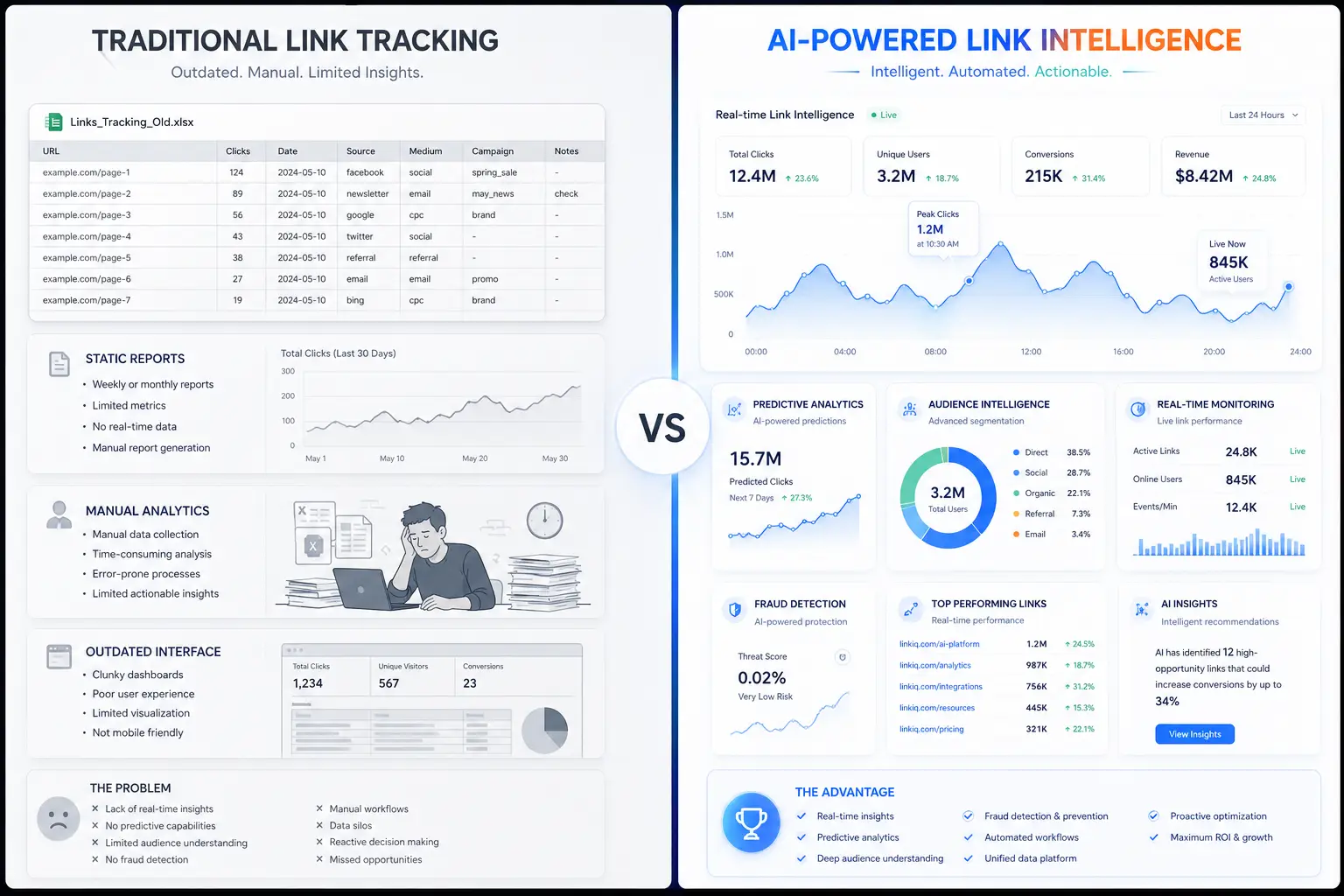
Comparison: Traditional Link Tracking vs. AI URL Tracking & Link Intelligence
| Feature | Traditional Link Tracking | AI URL Tracking & Link Intelligence (2026) |
|---|---|---|
| Data processing speed | Batch processing — hourly or daily reports | Real-time stream processing — sub-second insights |
| Bot detection | Basic IP blocklists and user-agent filters | ML classifiers trained on billions of interactions |
| Audience intelligence | Device type, location, referrer — static segments | Dynamic behavioural clustering and intent scoring |
| Attribution modelling | Last-click or first-click only | Multi-touch AI attribution with probabilistic weighting |
| Predictive capability | None — purely historical reporting | Engagement forecasting and performance prediction |
| Privacy compliance | Heavily cookie-dependent; fragile post-2024 | Cookie-free cohort modelling; GDPR/CCPA aligned |
| CRM integration | Manual export and import workflows | Native bidirectional API integration with enrichment |
| Anomaly detection | Manual review — reactive only | Automated real-time alerts with root cause analysis |
Real-World Use Cases for AI URL Tracking & Link Intelligence
Across industries, forward-thinking organisations are deploying URL intelligence for marketing and operations to unlock competitive advantages. Here are the most impactful applications in use today.
Email Marketing Campaigns
Email remains one of the highest-ROI digital channels, but its analytics have historically been shallow. With AI link intelligence embedded in every tracked link within an email, marketers can now understand not just open rates and click rates, but which specific content types drive downstream conversions. HubSpot’s marketing benchmark research consistently highlights that personalisation — driven by behavioural data — produces significantly higher email engagement. AI link tracking makes that personalisation loop dynamic and automatic.
Influencer and Affiliate Programme Management
For brands running affiliate or influencer programmes, AI-powered link monitoring solves a persistent challenge: determining which partners actually drive quality traffic versus those who inflate numbers with low-intent or fraudulent clicks. AI attribution systems can assign quality scores to each affiliate link based on downstream engagement signals — time on site, pages viewed, cart additions — rather than just clicks.
B2B Account-Based Marketing (ABM)
In B2B contexts, AI link intelligence integrates with CRM platforms like Salesforce Marketing Cloud to match link interaction data to known company accounts. When a prospect from a target account clicks a tracked link, the system can trigger an automated CRM activity, alert a sales representative, or enrol the account in a personalised follow-up sequence — all without any manual intervention.
Product Launch and Event Promotion
During high-stakes product launches or event promotions, AI link analytics provide real-time visibility into audience response. Marketing teams can see within minutes whether a launch email is resonating, which social posts are driving the most qualified traffic, and whether the campaign is trending toward its targets. This enables real-time optimisation decisions that legacy tools could never support.
QR Code Campaigns in Physical Retail
QR codes — each containing a unique tracked URL — have become ubiquitous in retail, hospitality, and event environments. AI link intelligence enriches QR scan data with location context, device signals, and time-based behaviour patterns to give physical-world marketers the same analytical depth previously available only in digital channels.
Challenges and Solutions in AI URL Tracking
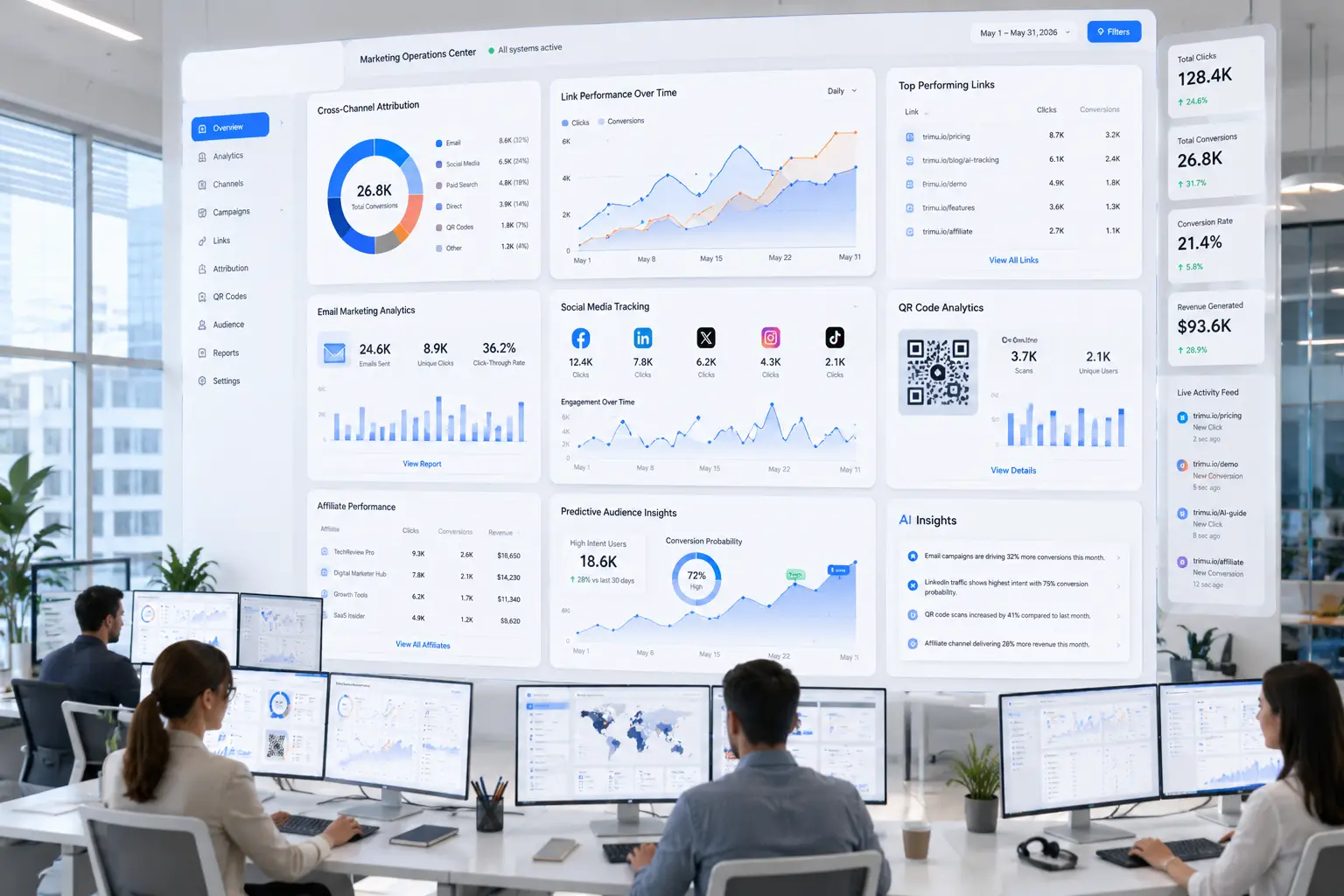
Adopting AI URL Tracking & Link Intelligence is not without complexity. Understanding the common challenges — and how mature platforms address them — is essential for making informed implementation decisions.
Challenge 1: Data Volume and Infrastructure Costs
AI link analytics requires processing enormous volumes of event data in real time. For enterprise-scale campaigns generating millions of link interactions daily, infrastructure costs can escalate rapidly if not managed efficiently.
Solution: Modern platforms built on cloud-native architectures — leveraging services from providers like AWS analytics infrastructure — use serverless event processing to scale elastically with demand and charge only for actual compute usage. This eliminates the need for over-provisioned static infrastructure.
Challenge 2: Privacy Regulation Compliance
As regulations evolve, ensuring that link tracking practices remain compliant across multiple jurisdictions is an ongoing operational challenge.
Solution: AI link platforms that are designed privacy-first from the ground up — using aggregate cohort modelling, consent management integrations, and data residency controls — allow businesses to maintain analytical depth while respecting user rights. Consent signals can be embedded directly into smart link parameters and honoured throughout the analytics pipeline.
Challenge 3: Model Accuracy and Bias
AI attribution and predictive models are only as good as the training data used to build them. Models trained on historically biased or incomplete datasets can produce misleading insights.
Solution: Enterprise-grade AI link intelligence platforms employ continuous model retraining pipelines that update scoring models as new behavioural data accumulates. Bias monitoring and explainability layers allow data teams to audit model decisions and intervene when drift is detected.
Challenge 4: Integration Complexity
Connecting AI link analytics outputs to existing marketing technology stacks — CRMs, CDPs, DSPs, email service providers — can be technically complex, especially in large organisations with heterogeneous tool ecosystems.
Solution: Platforms that offer REST API access, pre-built webhook integrations, and native connectors to major marketing platforms significantly reduce integration friction. OpenAI’s function calling capabilities, now widely adopted across SaaS platforms, also enable conversational AI interfaces that allow non-technical users to query link intelligence data in natural language.
Future Trends in AI URL Tracking & Link Intelligence
The trajectory of AI URL Tracking & Link Intelligence over the next two to three years is shaped by several converging technological and regulatory forces. Businesses that anticipate these trends will be better positioned to capture early-mover advantages.
1. Agentic AI in Link Campaign Management
The rise of autonomous AI agents — systems capable of planning and executing multi-step tasks — will transform link campaign management. Rather than simply reporting on link performance, AI agents will autonomously adjust campaign parameters, reallocate budgets toward high-performing links, and generate creative recommendations based on real-time performance signals. Microsoft’s enterprise AI strategy is already embedding agentic capabilities into business intelligence tools, and link analytics is a natural extension of this pattern.
2. Contextual Link Intelligence Without Cookies
As the advertising industry completes its transition away from third-party cookies, contextual intelligence — derived from the content surrounding a link, the device context, and real-time behavioural signals — will become the dominant paradigm. AI systems that excel at contextual inference will provide the richest audience insights in a cookie-free world.
3. Multimodal Link Tracking
Emerging link formats — including links embedded in AI-generated video content, interactive podcast transcripts, and augmented reality experiences — will require link intelligence platforms to expand beyond traditional web and mobile contexts. Multimodal AI systems capable of understanding link placement context across video, audio, and spatial computing environments will define the next frontier.
4. Federated Learning for Privacy-Safe Intelligence
Federated learning — a machine learning approach that trains models across distributed data sources without centralising raw data — will enable AI link intelligence platforms to improve their models using cross-organisational behavioural patterns while preserving the privacy of each organisation’s data. This will unlock collaborative intelligence benchmarks previously impossible due to data sharing constraints.
5. Link Intelligence as a Revenue Attribution Standard
Within enterprise organisations, AI link intelligence will increasingly serve as the backbone of revenue attribution frameworks — providing the granular, cross-channel data needed to connect marketing investments directly to pipeline and closed-won revenue with statistical confidence.
Best Practices for Implementing AI URL Tracking & Link Intelligence
Success with predictive link tracking software and AI link intelligence depends as much on implementation strategy as on technology selection. The following best practices reflect patterns observed across successful enterprise deployments.
-
Establish a clean UTM taxonomy before implementation.
AI models produce better insights when input data is consistently structured. Standardise UTM parameter conventions across all teams before connecting AI intelligence layers to your link data. -
Integrate link intelligence with your CRM from day one.
The full value of AI link data is realised when it is connected to customer records. Prioritise CRM integration as a first-phase deliverable, not an afterthought. -
Define KPIs that go beyond click volume.
Set success metrics that reflect business outcomes — qualified traffic rate, downstream conversion rate, revenue influenced per link — rather than vanity metrics like total clicks. -
Implement bot filtering thresholds appropriate to your business.
The right invalid traffic filtering sensitivity varies by use case. Work with your platform provider to calibrate thresholds that balance precision with recall for your specific traffic profile. -
Build a data governance framework for link intelligence data.
Define data retention policies, access controls, and compliance review cadences for all link interaction data before scaling programmes internationally. -
Run A/B tests at the link level to feed the AI.
AI models improve with richer, more varied training data. Systematically running controlled experiments across link variants — different destination pages, different anchor contexts, different distribution channels — accelerates model learning and produces better predictions over time. -
Review AI attribution models quarterly.
As your channel mix and audience behaviour evolve, attribution model parameters must be reviewed and recalibrated to maintain accuracy. Build this review into your quarterly planning cycle.
AI URL Tracking & Link Intelligence: FAQ
What is AI URL Tracking & Link Intelligence?
AI URL Tracking & Link Intelligence is the application of machine learning and artificial intelligence to collect, analyse, and interpret hyperlink interaction data in real time. It goes beyond counting clicks to provide behavioural insights, predictive analytics, bot detection, and cross-channel attribution — enabling businesses to make data-driven decisions based on link performance.
How does AI-powered link monitoring differ from traditional analytics?
Traditional link analytics tools record raw metrics such as click counts, referrer URLs, and geographic data in batch reports. AI-powered link monitoring processes these events in real time, applies machine learning to detect patterns and anomalies, filters invalid traffic automatically, and generates predictive insights — all without manual intervention. The difference is between passive reporting and active intelligence.
Is AI link tracking compliant with GDPR and CCPA?
Yes, when implemented correctly. AI link intelligence platforms designed for privacy compliance use aggregate cohort modelling, cookieless tracking methodologies, consent management integrations, and data residency controls that align with GDPR, CCPA, and other major privacy regulations. Businesses should verify their platform’s specific compliance certifications and data processing agreements before deployment.
What industries benefit most from smart link analytics platforms?
Any organisation that distributes links at scale benefits from smart link analytics. The industries with the most significant current adoption include e-commerce, SaaS, financial services, digital media, B2B technology, healthcare marketing, and retail. Within these sectors, marketing, sales, and business intelligence teams derive the most immediate value.
How do I choose the right AI URL tracking platform for my business?
Evaluate platforms across five criteria: real-time processing capability, bot detection accuracy, CRM and marketing stack integration depth, privacy compliance architecture, and quality of predictive analytics features. Pilot platforms against your actual link volume and channel mix before committing. For businesses already using URL shortening infrastructure, choosing a platform like Trimu.io that natively embeds AI intelligence into link management workflows reduces implementation friction significantly.
Conclusion: The Intelligent Link Is the Foundation of Modern Marketing
The shift from simple click tracking to full-spectrum AI URL Tracking & Link Intelligence is not a marginal improvement — it is a categorical change in what businesses can know and do with their link data. Every URL is now a potential intelligence asset. Every click is a data point feeding a model that gets smarter over time. Every campaign built on AI link intelligence operates with a level of contextual awareness and predictive precision that legacy tools cannot approach.
For businesses serious about digital marketing performance in 2026 and beyond, deploying a smart link analytics platform with genuine AI capabilities is no longer a future consideration. It is a present-day competitive imperative. The companies that treat their links as intelligence infrastructure — not just traffic conduits — will consistently outperform those that do not.
As AI continues to reshape how audiences are understood, reached, and converted, AI URL Tracking & Link Intelligence will serve as one of the most accessible, highest-leverage entry points into the intelligent marketing stack. Start building that intelligence layer now — because every link you share without it is an opportunity to learn that you are permanently leaving on the table.